


Greatest Hero Debate
This article was my contribution to a 'Greatest Hero Debate' at the Martime Museum.

Richard Been Stannard, VC.
Nature of courage
Courage comes in two forms. First there is the instinctive courage as when a someone dives into a foaming river to save a child. And then there is the considered, deliberate, drawn-out courage of a determined act.
Richard Been Stannard won his Victoria Cross for five days and five nights of persistent, deliberate and calculated courage at Namsos during the Second World War.
Stannard had only a humble command. As a mere lieutenant in the Royal Navy Reserve, he had charge of a commandeered Hull trawler, the Arab. It was in this tiny boat – a mere 531 tons – that he displayed, according to his citation, ‘outstanding valour and signal devotion to duty’. I hope to show you that this citation is a decided understatement.
The campaign
The action at Namsos was one of Neville Chamberlain’s numerous ‘too little, too late’ operations. Having stood by while Germany troops invaded Norway, the allies decided to send in troops in mid-April 1940. A key objective was to take Trondheim, a city well-invested by the Germans. The General Staff had backed the plan which, Churchill later said, was ‘one of the most difficulty and hazardous operations of the war’.[1] Then the generals got cold feet. A change of plan led to the decision to seize Namsos to the north of Trondheim and another town to the south. From these two places the plan was to close in on the city.
The occupation of Namsos began on 16 April 1940. It was doomed from the start for the simple reason that the Germans had total mastery of the air and the British did not possess a single airfield in Norway. Inevitably, Namsos was a sitting target for every German bomber within range.
NAMSOS BOMBED SLIDE
Twelve days later it was clear that Namsos could no longer be held. Evacuation was ordered.[2] But evacuation meant bringing in ships. Ships would attract German submarines. How were they to be protected?
The answer was trawlers.
And so, Lieutenant Stannard arrived at Namsos on 28 April with his trawler loaded with depth charges and heaped with courage.

A typical trawler used as auxiliary naval ships in WW2.
HMS Arab and her crew
Stannard’s ship, the Arab, was a Hull trawler, constructed at Middlesbrough. It had fished in the North Sea until the outbreak of war, when it was taken over by the Admiralty.
ARMED TRAWLER SLIDE
With only minimal modifications the Arab became an anti-submarine trawler. Stannard had a crew of just eight reservists. Stannard could never have achieved what he did had he had men who fled from fire. He was fortunate that his men had been with him since the beginning of the war. Clearly he had toughened them up before they faced five days and nights of being almost continuously at ‘action stations’. After the event, Stannard told the Admiralty that ‘Except for three ratings I can say they stood it very well.’ He must have been a man with very high expectations, since he and the remaining five men were to take a bag of a Victoria Cross, a Companion of the Distinguished Service order; a Conspicuous Gallantry Medal; and two Distinguished Service Medals. Five medals for eight men plus Stannard.
So what did they do to so distinguish themselves?
Stannard’s task
Just before leaving for Norway, Stannard wrote to a friend ‘I ought to see some fun over there. It is never an easy job in these small ships.’ He also remarked that ‘I never get my clothes off at sea.’[3] Whether what followed was his idea of fun, I don’t know. By the time that evacuation had been decided, the wooden houses of Namsos, its railway station, its church and its wharfs had been repeatedly bombed by the Germans. There was almost no visible sign of the small town and its 11 sawmills.
Sunday 28 April
As Stannard reached Namsos at 6.00 am on Sunday 28 April the place appeared to be deserted. There was no one in charge of the wharfs, while a French ammunition ship lay at anchor. He promptly organised the French ship’s unloading. Six hours later, when the wharf was stacked high with stores and explosive material, a German dive-bomber arrived and dropped a 500 lb bomb on the wharf. The stores and ammunition burst into flames.
BLAZING WHARF SLIDE
The wharf was the one that the troops were to use when the evacuation began. Stannard had to save it. He ran the bows of his boat into the wharf and, with his engines running, applied two hosepipes to the fire. There he calmly stood within yards of a great mound of explosive material, playing his hoses as if the conflagration was no more than a bonfire or a blazing garden shed.
Two hours later, when it was clear that Stannard was unable to bring the fire under control, his task was brought to an abrupt end by the arrival of 16 German bombers. Nevertheless, Stannard had succeeded in saving enough of the jetty for it to prove invaluable in the later evacuation.[4]
The Arab departed down the fiord, where Stannard found the Saumur in trouble with a cable round her propeller. He lashed the Arab to Saumur, keeping his engines running to prevent the French ship from drifting off. Meanwhile, fresh waves of German bombers menaced up and down the waterway.
That night there was no rest for Stannard and his men as they ferried 850 French Chasseurs Alpins from the shore to an awaiting transport.
Monday 29 April
By the next morning Stannard was not just tired, but was suffering from frostbite and a bullet wound – he mentioned neither injury in his later despatch.
The German bombers returned at 5.00 am and dropped 16 bombs around the Arab. All missed although the engine room and the propeller suffered minor damage. That the damage was so limited was in no small part due to Stannard’s coolness under fire. He calmly observed and analysed the German bombing technique and each time a bomber descended from 10,000 feet, he manoeuvred the Arab to present her beam as the bomber flattened out at 3,000 feet. This, he later said ‘saved the Arab’. But, although Stannard did not know it, the limited damage that the ship had suffered was to reduce her maximum speed.
Stannard was able to take the Arab back to Namsos and anchor it in the shelter of a cliff so that his men could get some rest - they had not slept for 48 hours.
Another bombing raid followed at 1.00 pm. In fact the day was one of unrelenting air attacks on the trawlers which, until the sloop HMS Bittern arrived in the evening, were the sole occupants of the fiord. Stannard noted that day ‘Cannot keep track of the number of air attacks made.’ He estimated that the Germans were making 6 to 9 raids every hour.
Tuesday 30 April
The German bombing recommenced the next day.
The arrival offered of the sloop HMS Bittern brought no relief for Stannard and his men: they were promptly told to take station to cover the arrival from the aerial attacks.
At mid-morning Stannard was called to the aid of the trawler Saint Goran, which was sinking after being struck by German bombs. By the time the Arab arrived, Saint Goran’s crew were in her lifeboat. Under constant bombing, Stannard’s men hauled aboard the hapless crew plus a badly injured Royal Marine. In his report Stannard recalled that he had ‘Attempted to do as much as possible to dress the seriously wounded man with the limited supply from our medical chest.’
By this stage two more trawlers – the Aston Villa and the Gaul – were disabled, while Arab had broken castings and a damaged propeller. It was not a good moment to hear from the cruiser HMS Carlisle that enemy ships were expected, along with submarines. Stannard was ordered to ‘prepare to engage enemy’.

HMS Aston Villa.
Ever resourceful, Stannard, still under air attack, prepared to land men and Lewis guns to occupy a cave in the cliff side together with gun emplacements on the cliff top.
CLIFF TOP DEFENCES SLIDE
Stannard had kept Gaul’s crew with him and he still had some stores from the Saumur on deck. He recalled ‘I took the liberty of opening same, finding automatic rifles and ammunition, a 60 m/m bomb-throwing mortar with bombs and detonators complete.’ By the end of the day, the cliff bristled with 6 Lewis guns, 2 automatic rifles and a bomb-thrower. At the foot of the cliff lay the Arab with her 4-inch gun covering the fiord entrance. That night his men slept by their guns.
Wednesday 1st May
There was no let up on the 1 May. Early that day it was clear that Aston Villa, which had been hit by a bomb, was in danger of blowing up. If she went, she would take the Arab with her.
ASTON VILLA SLIDE
Stannard had been warned by a Commander Congreve to keep away, but he and two of his men boarded the Arab, cut her lines and moved her off. When only 100 yards from Arab, Aston Villa blew up.
That night, at 11.00 pm, the Arab was at work embarking the wounded, together with stores and guns, along with the three trawler crews. Stannard laconically recalled that he ‘Was told to do same with all despatch.’
During the day the Bittern had been subjected to continued dive-bombing attacks. The ship was finally hit and caught fire in the afternoon.
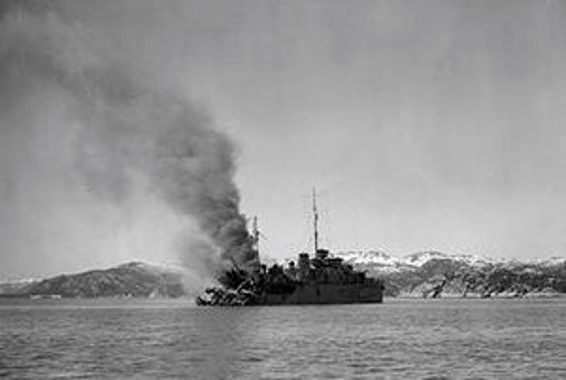
Bittern on fire.
BITTERN FIRE SLIDE
Stannard moved in with Arab and took off Bittern’s wounded. He and his men improvised stretchers from the ubiquitous local fir trees and took the injured men to the relative safety of the cliff tops.
Thursday 2 May
The evacuation had been completed by Thursday 2 May. Stannard had handed over the wounded to the destroyer HMS Griffin. It was time to go home. Surely Stannard’s travails were over.
But no.
The damaged Arab could only manage 5-6 knots so could not keep station with the other returning ships. Stannard set off alone northwards in the hope that his small vessel would not be spotted. He cleared the fiord at 11.00 am, running at a pathetic 3 knots. Then out of the sky came a Heinkel-115.
HEINKEL SLIDE
Its pilot signalled to Stannard ‘Go east or be sunk’. But the pilot had not reckoned on the courage of his adversary. Enigmatically Stannard responded with what he called ‘a suitable answer’ and kept his course. The plane circled the Arab, its guns firing, but Stannard held his fire. Then, at 800 yards, all Stannard’s guns burst into life. The Heinkel fell from the sky at a distance of 2 miles from the Arab.
Stannard maintained his northerly route and put in at Scapa Flow at 5 pm on 6 May.
I have concentrated my case on Stannard’s dazzling courage at Namsos. It is worth mentioning that, a few weeks later, he was playing his a similar role in that other great evacuation: Dunkirk. It was, he said, ‘a picnic compared to the hell of Namsos’.[5] He was once more mentioned in despatches in December 1940 when bombed while escorting a convoy. In 1942 he received the Norwegian War Cross for his actions at Namsos and in 1943 he received the Distinguished Service Order for taking part in a three day and night running battle to hunt down a U-boat.[6] In August 1940 he became the first naval reservist to be awarded a VC.
Conclusions
STANNARD SLIDE
Well, I told you at the outset that Stannard had shown ‘persistent, deliberate and calculated courage’. I hope that I have now convinced you. Over a period of five days Stannard had:
run his ship into a blazing wharf
fought for 2 hours a fire that could at any moment engulf Stannard, his ship and his crew in a fire-ball
rescued the crew of the Gaul, while under continual air-attack
rescued the crew of Aston Villa
commandeered and put to good use the two rescued crews
resourcefully collected guns and men to install defensive bases on the cliff
boarded the Arab after having been warned off, and successfully saved her from Aston Villa’s explosion
defied a Heinkel-115 and shot it down
and he brought all his men home.
Richard Been Stannard was a truly remarkable man. Under fire and with little or no sleep for a week he showed initiative; he showed resource; he showed leadership. But above all he showed courage beyond all expectations.
.............
I was debating against . Patrick Bishop spoke next. He had little to say on Leonard Cheshire and Patrick Mercer gave a vivid account of the heroics of Major William Sidney's actions at Anzio beach. I expected to do badly since Stannard was unknown to the general pubic, but he did well with the votes being 18 for Sidney, 17 for Cheshire and 16 for Stannard).
.............
[1] Hobhouse diary 7 April 1915 in (David 1977), p 234.
[1] Churchill ‘The Gathering Storm’, p. 494.
[2] Churchill ‘The Gathering Storm’, p. 508.
[3] Sydney Morning Herald, 19 Aug 1940.


Comments